
April 2026 Visa Bulletin Released
The Department of State (DOS) has published its April 2026 Visa Bulletin. In April, most employment and family-based categories will see forward movement. Fortunately, no categories will retrogress.
For employment-based final action dates, the EB-1 category for nationals of India and China will move forward in April, and EB-1 will remain current for the rest of the world. The EB-2 category will advance for nationals of India, and the EB-3 category will move forward for all nationals except for nationals of India and the Philippines.
For family-based final action dates, the F-1 category will advance for all nationals. The F-2B and F-3 categories will move forward for all nationals except for nationals of Mexico. The F-4 category also will move forward for all nationals except for nationals of India and Mexico.
In addition, USCIS will continue to honor the Dates for Filing Chart for both employment and family-based petitions in April (charts provided further below). Many of these dates will also progress in April. Most notably, EB-3 is now current worldwide, except for nationals of China and India. This is the first time in several years that all employment-based categories are current worldwide. These dates are also much further ahead than the Final Action Dates, so more beneficiaries of all immigrant visa petitions can get their applications filed and obtain interim employment and travel benefits until the government can actually approve their application.
The significant forward movement in April may reflect reduced immigrant visa issuance abroad following the State Department’s pause on immigrant visa processing for nationals of 75 countries. Since there is a limited number of green cards available each fiscal year, reduced visa issuance at consulates will leave more numbers available for adjustment of status applicants in the U.S.
Employment-Based Movement
In April, the EB-1 category remains current worldwide, except for Chinese and Indian nationals, who will advance by one month.
The EB-2 category will become current for all nationals except for nationals of China and India. EB-2 India will advance by ten months, while EB-2 China will remain the same.
The EB-3 category will move forward by eight months for all nationals, and six weeks for nationals of China. EB-3 India and the Philippines will remain the same.
The EB-3 Other Workers category (for positions requiring less than two years of training), will advance by seven weeks for nationals of China, and remain the same for all other nationals.
Here’s a chart for easy reference:
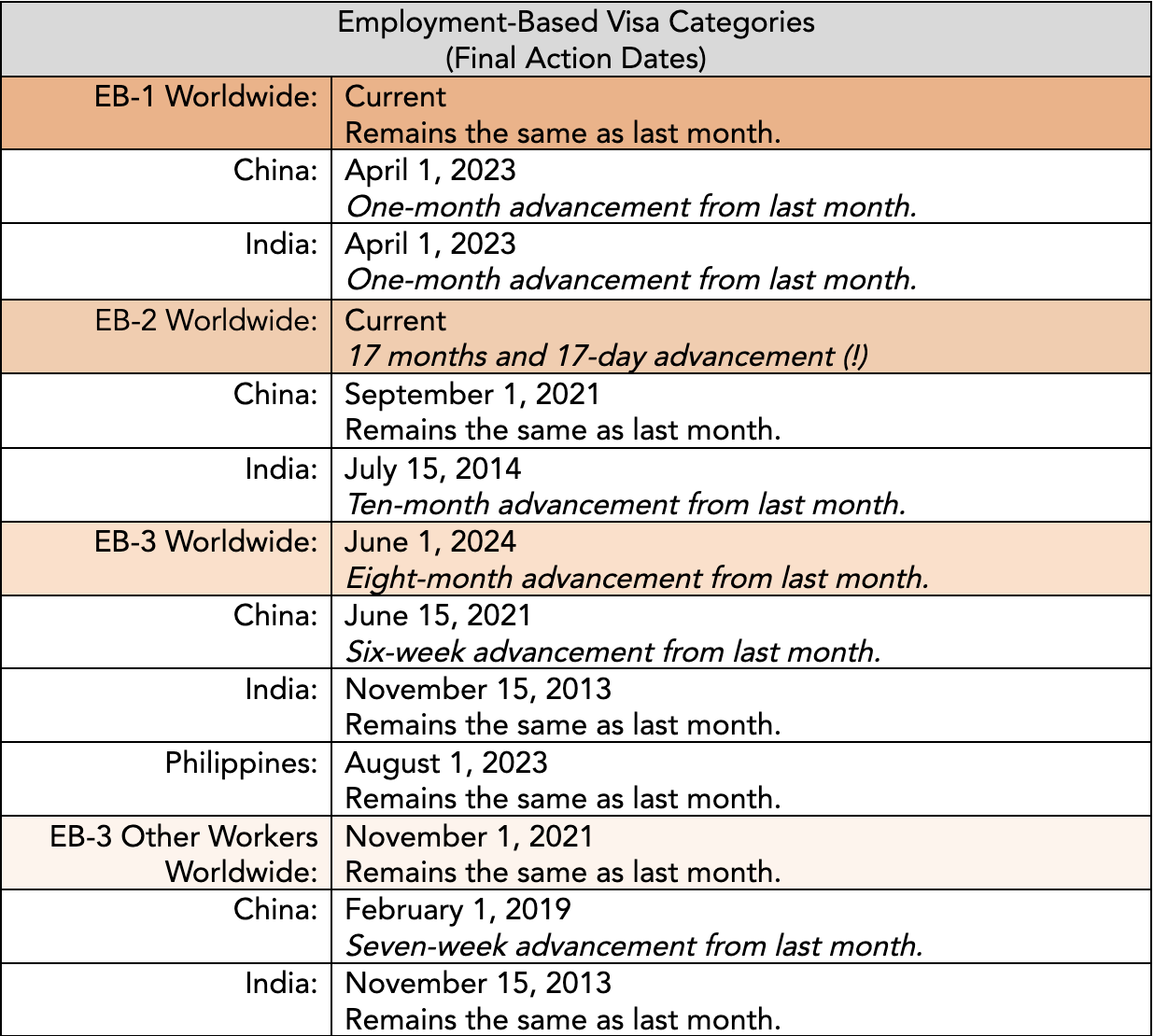
That said, USCIS will honor the Dates for Filing (further below), which are further ahead than Final Action Dates.
Family-based Movement
In April, the F-1 category will advance by almost six months for all nationals except for nationals of Mexico and the Philippines. Nationals of Mexico will see a seven-week advancement, and nationals of the Philippines will see a two-month advancement.
The F-2A category will remain the same for all nationals.
The F-2B category will advance by five months and three weeks for all nationals, except for nationals of the Philippines and Mexico. F-2B Philippines will move forward by three months and two weeks. F-2B Mexico will remain the same.
The F-3 category will advance by three months and two weeks for all nationals, except for nationals of the Philippines and Mexico. F-3 Philippines will move forward by four months. F-3 Mexico will remain the same.
The F-4 category will move forward by six months for all nationals, except for India, Mexico and the Philippines. F-4 Philippines will advance by five months. F-4 will remain the same for nationals of India and Mexico.
Here’s a chart for easy reference:
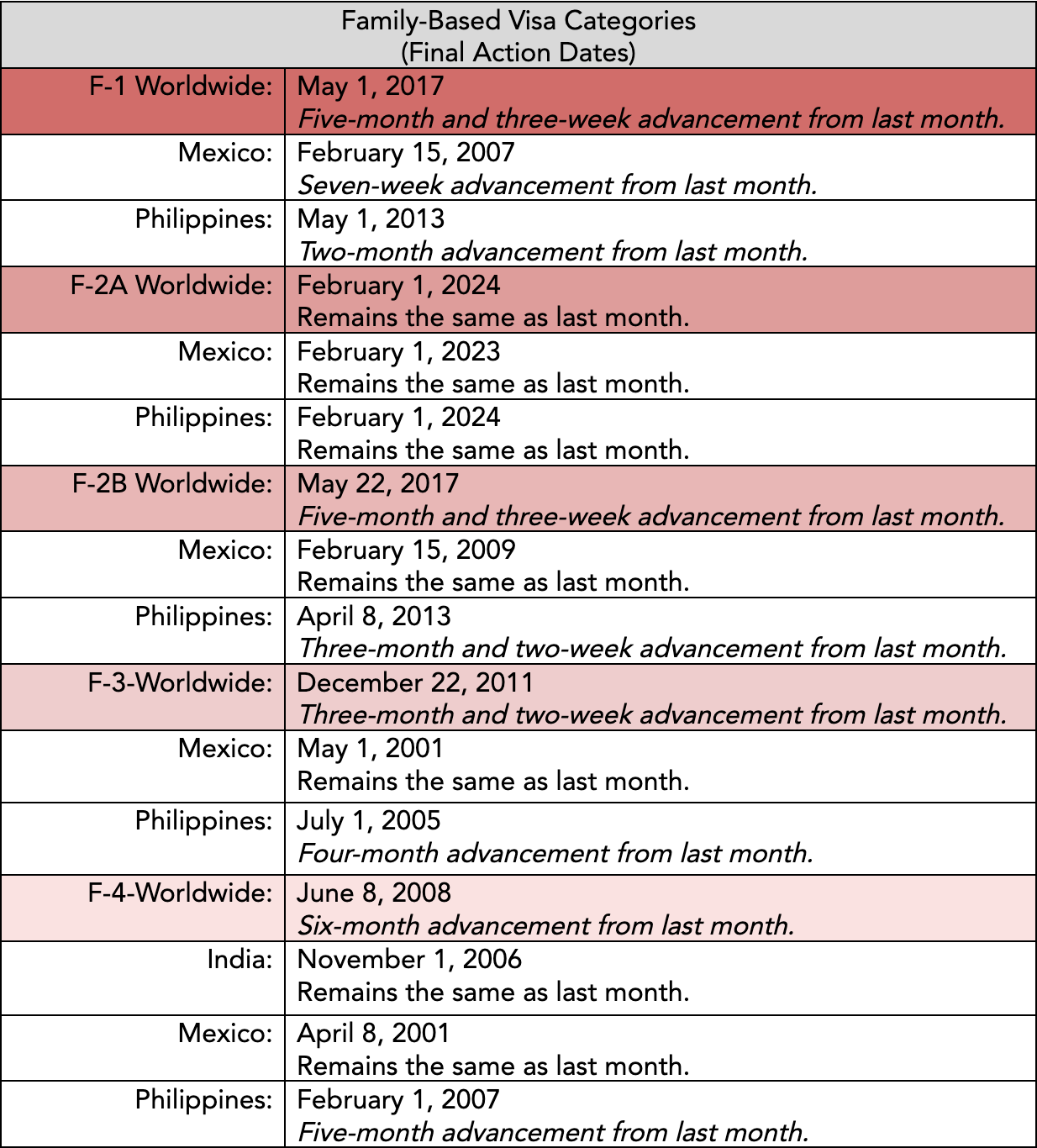
As mentioned previously, USCIS will honor the Dates for Filing chart (further below) for family-based immigrant visa categories.
By way of reminder, the categories are:
F-1 category: unmarried sons and daughters of U.S. citizens
F2-A category: spouses and children under 21 of lawful permanent residents
F2-B category: unmarried adult children (over 21) of lawful permanent residents
F-3 category: married sons and daughters of U.S. citizens
F-4 category: siblings of U.S. citizens
WHAT DATES IN THE VISA BULLETIN SHOULD YOU USE FOR FILING YOUR ADJUSTMENT OF STATUS APPLICATION WITH USCIS?
If USCIS determines that there are more immigrant visas available for a fiscal year than there are known applicants for such visas, then USCIS will state here that you may use the Dates for Filing Visa Applications chart in the Department of State Visa Bulletin, which usually has dates later than the Final Action Dates noted above. Otherwise, USCIS will indicate on its website that you must use the Application Final Action Dates chart (above) to determine when you may file your adjustment of status application in the United States.
For April 2026, USCIS has confirmed the Dates for Filing (below) should be used for both family and employment-based categories.
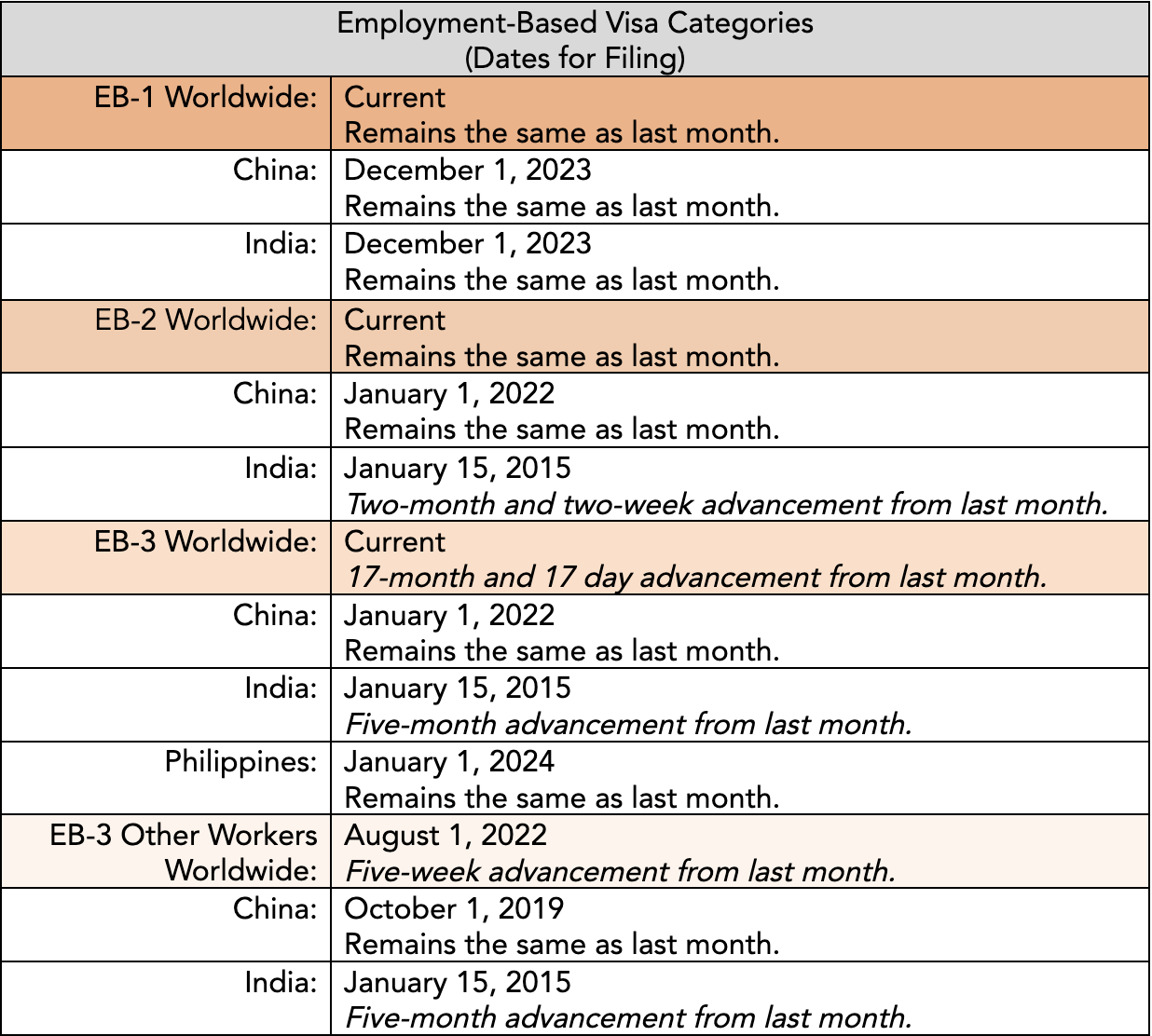
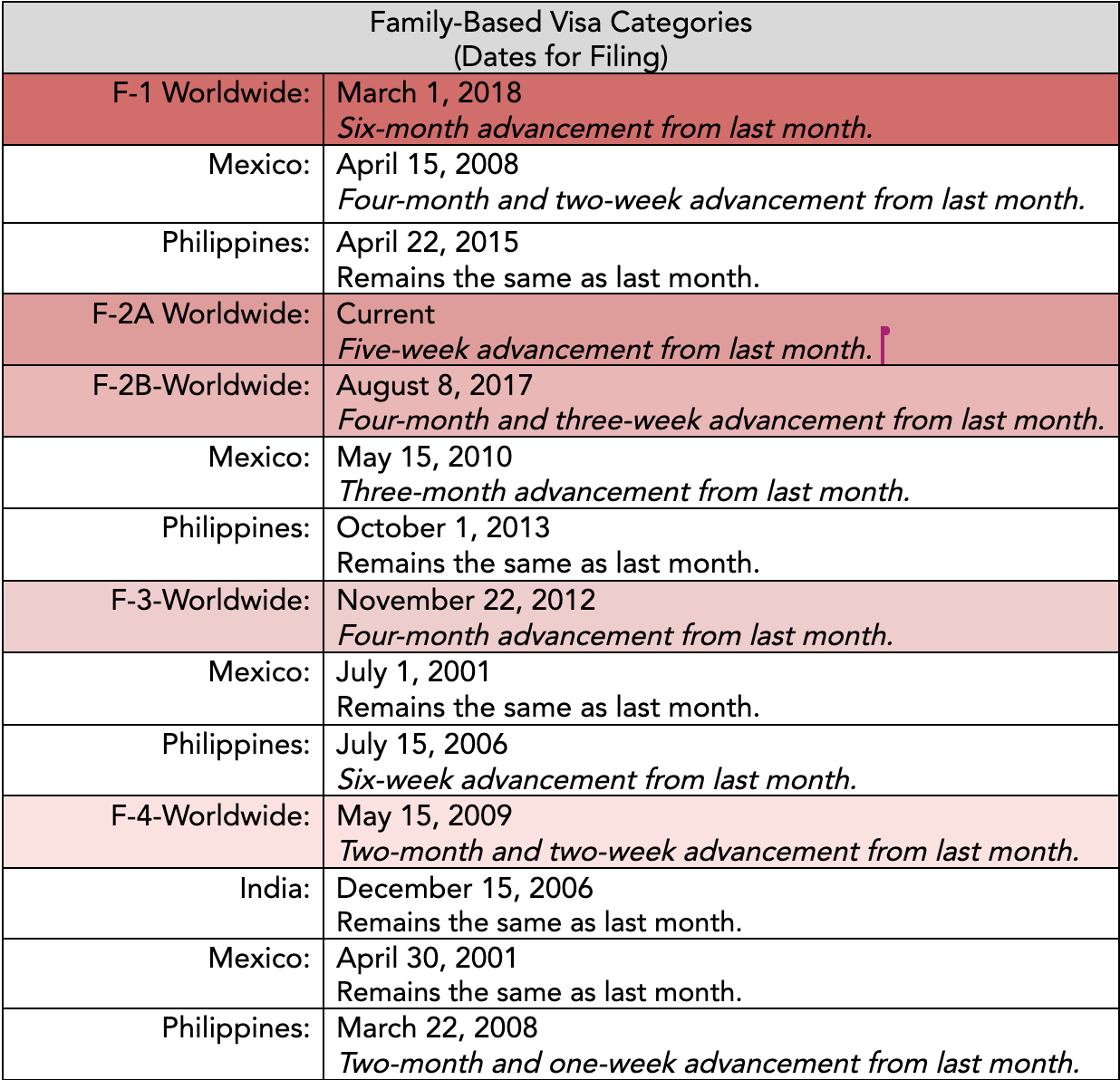
If the priority date for your employment or family-based category is before the date listed above and you are in the United States, you may file your application to adjust your status along with the applications for employment authorization and travel permission (assuming you have no bars to admissibility) with USCIS in April.
The entire visa bulletin is available on the State Department’s website, which includes information on the diversity visa lottery and the EB-5 priority dates.
If you would like more information on how to understand the monthly visa bulletin, please check out our blog post on this topic and our podcast available here.
This alert is for informational purposes only. Please contact us if you would like to discuss these developments further.